
What My First Ultra Taught Me
Every endurance event teaches us something. In this blog, Lisa reflects on preparing for and completing her first 50km ultra marathon, sharing honest lessons on injury, training, nutrition and trusting the process.
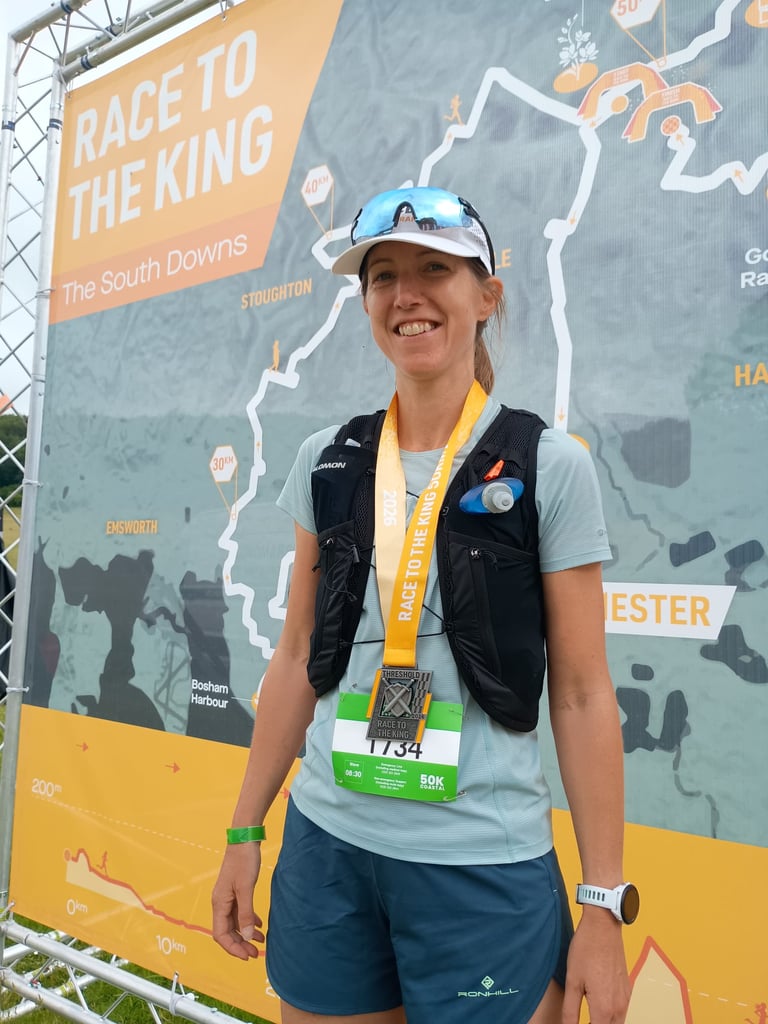
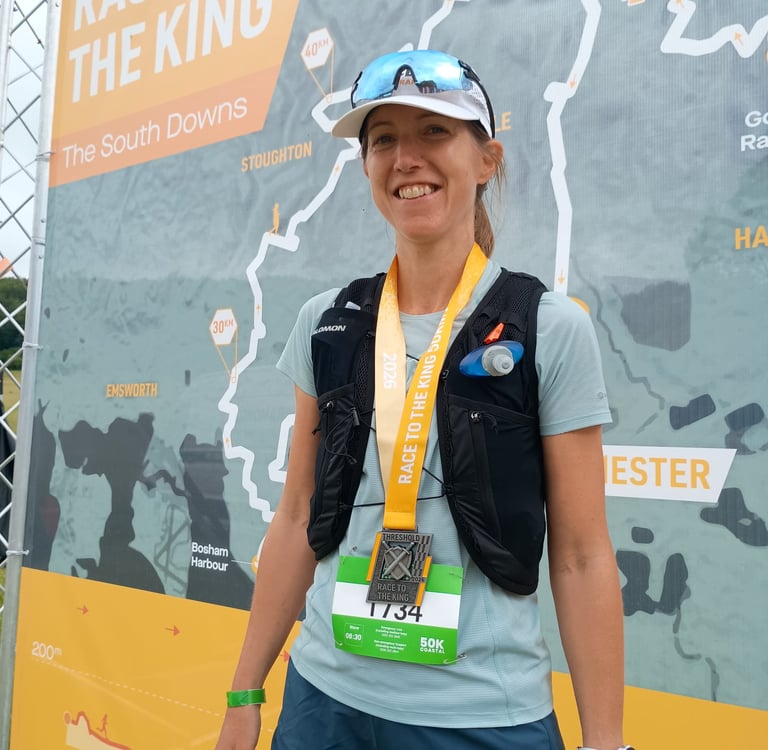
Written by Lisa, Sports Nutritionist at Ascend Endurance
This time last year, an ultra marathon wasn't even on my radar.
I'd recently moved to a new area and was happily spending most of my time on the bike, enjoying rides with the local cycling club as a way to meet new people and explore the surrounding landscape. I'd run a 10km PB earlier in the year, but other than that my running was just ticking over. I was swimming regularly in open water and had started thinking about targeting a full Ironman in 2026.
Funny how quickly plans can change.
After racing SGRAIL Triathlon in Girona last October, my outlook shifted. The whole atmosphere of the event was unlike anything I'd experienced before. It was relaxed, friendly and seemed to celebrate why so many of us started endurance sport in the first place. It wasn't about chasing times or putting pressure on yourself; it was about enjoying being outdoors, exploring beautiful places and sharing the experience with others.
At the same time, Dan had entered Northumbrian Triathlon for June 2026. The day before the triathlon was a 50km ultra marathon, and I remember thinking it would be something fun to do whilst we were there.
Without really realising it, a 50km ultra had quietly become my goal.
Sometimes the biggest challenge isn't the race
Training started well, but after only a couple of weeks I injured my back in the gym.
The injury meant three weeks with no training at all and, for around ten days, I could barely walk. Just as I was beginning to get moving again, I was hit with two bad colds back-to-back. Altogether, I lost around six weeks of structured training.
Like many athletes who have been injured, returning to running was a humbling experience.
Running felt hard. Really hard.
My heart rate was far higher than I expected, and everything felt more difficult than it should have done. Previously I'd known that running at a certain pace would produce a certain heart rate. Suddenly those numbers meant very little.
One of the biggest lessons from the injury was learning to stop comparing myself to the runner I had been six weeks earlier.
Instead, I had to run on feel.
Ignore the watch.
Ignore the pace.
Trust that consistency would eventually bring everything back.
Slowly, it did.
Trusting someone else
My return to running was led by Sophie, who carefully rebuilt both my running volume and, perhaps more importantly, my confidence in my back. Once I could comfortably run for around an hour, Dan took over and shifted the focus towards preparing specifically for an ultra.
As coaches ourselves, it's easy to think we should always know the answers.
This experience reminded me how valuable it is to be the athlete.
Having someone else make the bigger decisions removed a huge amount of mental load. Rather than constantly questioning whether I was doing too much or too little, I could simply trust the process and focus on turning up each day.
I didn't expect to enjoy the training so much
One of the biggest surprises was just how much I loved training for an ultra.
I found myself exploring running routes I'd never been on before and looking forward to spending longer outdoors. We focused on building consistent weekly run volume rather than simply chasing longer and longer runs. Every couple of weeks I'd complete a longer run where I could test my kit, practise my nutrition and refine my run-walk strategy.
Because I was fuelling those longer sessions properly, they felt enjoyable rather than something to simply survive.
Perhaps the biggest surprise was how good I often felt afterwards.
I'd head out for a two or three-hour run, then wake up the following day genuinely wanting to run again. That wasn't something I'd expected before starting ultra training.
Looking back, one of the biggest surprises wasn't that I could eventually run 50km. It was how normal it began to feel. Months of consistent training had quietly turned something that once seemed intimidating into something that felt achievable.
Race day: the lessons really began
Unfortunately, Dan's own injury meant he had to withdraw from Northumbrian Triathlon, so I started looking for another ultra around the same time of year. That's how I found Race to the King.
I chose the 50km coastal route because, on paper, it looked flatter and therefore easier.
Looking back, I'm not convinced that was actually the easier option!
The route stayed relatively flat until around 37km before introducing the hills. In hindsight, having the climbing spread throughout the race might actually have been preferable, giving different muscles a chance to work earlier rather than asking the same ones to do almost everything for over three hours.
Pacing wasn't the challenge I expected
Going into race day, pacing was my biggest concern.
With such a flat opening section, I worried I'd run too fast simply because it felt comfortable, leaving nothing for the closing stages.
In reality, that wasn't the problem at all.
My heart rate remained controlled, my pacing felt sensible and physically I never felt like I'd gone out too hard.
Even sports nutritionists get it wrong
As a sports nutritionist, I wasn't expecting nutrition to be the biggest lesson from the day.
I'd practised my race nutrition throughout training and felt confident in the plan.
Around 20km into the race, though, I started feeling nauseous.
From that point onwards, eating became increasingly unappealing.
I kept fuelling because I knew I needed to, but nowhere near enough.
Looking back, I don't think my pace faded because I'd paced badly. I simply didn't have enough energy left during the final stages.
It was a useful reminder that knowing the theory and executing it on race day aren't always the same thing.
That's something I'll certainly be working on before my next ultra.
Your body always teaches you something
The race also highlighted things that no amount of training could fully reveal.
The climbs were absolutely fine.
The descents, however, brought excruciating pain around my left fibular head.
Then there were things that didn't even appear until after the race. Four days later I completed a light gym session, only to wake the next morning with my adductors and quadriceps so sore I could barely walk downstairs.
Rather than seeing these as negatives, I see them as useful feedback.
Training prepares you incredibly well, but there are some things that only reveal themselves after five and a half hours on your feet.
No one really does an ultra alone
Although ultras often look like individual events, they rarely feel that way.
Dan was my support crew throughout the day and somehow managed to reach me at two different points on the course after covering nearly 30km himself on a mountain bike.
Knowing someone is waiting for you, tracking your progress and encouraging you along the way makes more difference than you realise.
Sharing stories afterwards with someone who's experienced the journey alongside you, from the first training run through to the finish line, is something quite special.
More than just a finish line
Crossing the finish line, I knew I'd given absolutely everything I had.
I'm not sure I've ever pushed myself that deeply before, even having completed several 70.3 triathlons.
I finished in just under five and a half hours, placing 4th in my age group, 14th female and 38th overall.
Those results were a lovely bonus, but they were never really what the day was about.
This was my first ultra.
It was always about learning.
The learning started months before race day, continued throughout training, and will carry on long after I crossed the finish line.
What's next?
People often seem to assume that once you've completed one ultra, the next challenge has to be longer.
50km becomes 80km.
80km becomes 100km.
100km becomes 100 miles.
For now, that isn't my plan.
I'll be back to run another 50km next year.
Not because I don't want to go further one day, but because I feel there's still so much to learn from this distance.
My first ultra gave me far more questions than answers, and that's exactly what makes it exciting.
Sometimes progress isn't about chasing the next, bigger challenge.
Sometimes it's about taking everything you've learned, applying it a little better next time, and enjoying the journey along the way.
The medal will eventually end up in a drawer. The lessons won't. They'll shape the next ultra I run, the advice I give my athletes, and remind me that no matter how much experience we have, endurance sport always has something new to teach us.
hello@ascend-endurance.com
Copyright @Ascend Endurance 2026